
The continuous avalanche of cardiac remote monitoring data doesn’t just challenge traditional care models—it strains fragmented departments, limits clinical visibility, and introduces risk for revenue leakage and missed patient events
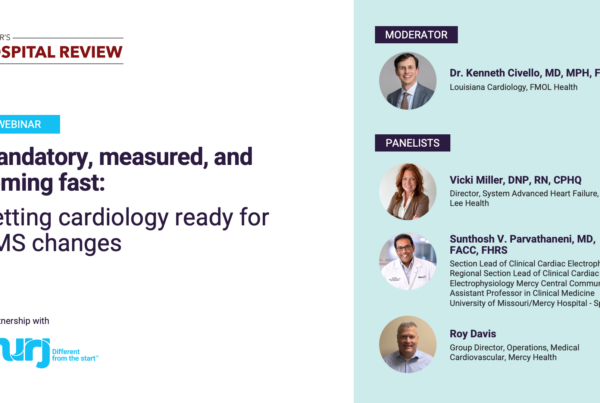
In this webinar hosted by Becker’s Hospital Review and sponsored by Murj®, moderator Dr. Kenneth Civello joins healthcare leaders to explore how unified data integration and active remote monitoring can transform patient management, clinic operations, and more.
The panel dives into what it takes to move from siloed, episodic care systems to connected, team-based ecosystems that support faster decision-making, more efficient workflows, and better patient outcomes
From real-world examples of missed device data to measurable gains in centralizing operations and scaling infrastructure, the conversation highlights both the urgency of the problem and the opportunity ahead
Watch the full discussion below, and read on to explore key takeaways and insights.
Faculty
- Kenneth Civello, MD, MPH, FACC, Electrophysiologist, Louisiana Cardiology, FMOL Health
- Gopi Dandamudi, MD, MBA, Founding President, Heart & Vascular Institute, Prisma Health
- Troy Leo, MD, MHCM, FACC, Leader, Heart & Vascular Service Line (NC/GA Division), Atrium Health
- Gordon B. Wesley, DBA, FACHE, Chief Strategy & Clinical Integration Officer, UChicago Medicine AdventHealth
Key takeaways
- Consolidation is crucial: Cardiovascular programs must move away from fragmented, siloed structures and integrate into unified service line platforms to handle the growing volume of remote monitoring data effectively.
- A shift to team-based “streaming care”: The sheer volume of continuous data necessitates transitioning away from traditional episodic visits toward protocol-driven, team-based care models.
- Infrastructure prevents vulnerability and revenue leakage: Centralizing clinic operations and investing in active monitoring workflows protects health systems from staff turnover and ensures proper reimbursement
Detailed insights
Consolidation is necessary for scaling growth
Cardiovascular care has historically operated in distinct subspecialties like electrophysiology (EP) and heart failure. However, managing the influx of remote monitoring data requires a cohesive strategy that integrates workflows and software platforms under one roof to build a foundation for growth.
“I think the philosophical nuance to this is we can’t scale something that’s fragmented. All the technologies, innovations, the way we interact and take care of patients—that can’t be fragmented. And so you have different readers, different reader expectations, potentially different billing systems, different workflows, different protocols, decision making. So, yes, “consolidate” is a bad word, but in this sense, it’s a positive word.”
– Gordon B. Wesley
“If I’m the patient, I want all that information coordinated and actionable. I don’t want one part of it to live with primary care, one part to live with EP, and one part to live with heart failure. So I think that’s the next iteration where, how do we get all of this together so that all of us are working together to manage that one patient, not in our own unique environments but collectively? I think it is our biggest challenge right now by far.”
– Dr. Gopi Dandamudi
The evolution from episodic care to “streaming care”
The rise of wearable technologies and remote implantable devices has created a continuous stream of patient data, challenging the traditional model where patients are only evaluated during in-person visits. As friction is removed from data collection, organizations must transition from episodic treatments to continuous, team-based care to manage the resulting influx of information.
“We are moving into this ‘streaming’ care time. And to me, wearables or implantables remove the friction that’s involved. And once you remove the friction, we’re going to get a data avalanche or things are going to come in separate places.
We need to get to the point where all of those care teams come together—we move to a team-based approach with protocols in place that allow us to care for the patient as that continuous data comes in.”
– Dr. Kenneth Civello
“We’ve really leaned into team-based care. Because I think physicians are doing so much and their time is too valuable—because we need them in EP labs doing imaging, doing procedures—to necessarily take all these pieces of information and act upon it.
And I think that’s where building teams of—we’ve built teams of pharmacists, nurses, nurse navigators, APPs—to either protocolize care in the way that we’ve talked about or help warm handoff that care to other parts of our system, whether it’s primary care, virtual care, or other partners in a cardiology suite that weren’t doing those parts of the care at the beginning.”
– Dr. Troy Leo
Centralized infrastructure mitigates staffing vulnerabilities
Relying heavily on the institutional memory of a single experienced device tech or nurse creates a significant point of failure for health systems. Centralizing services builds vital operational resilience. Remote-based clinics backed by standard operating procedures ensure that patient care does not falter when inevitable staff turnover occurs.
“We had a 10-plus year device tech and when that individual leaves, they take the way we do things, they know the patients’ nuance… and they take all of that with them. To be an excellent clinic through a system approach versus an individual approach, you really have to protocolize and you have to put those things transparently out there.
Then you train the trainer, but every device tech and the nurses and the staff have the same set of standards. They’re able to move pretty fluidly in a device clinic and they understand the role. You have to protocolize that and put in an algorithm form that everyone understands.”
– Gordon B. Wesley
“I’ve always been a big proponent of centralized services, not localized services. So we don’t have a local device clinic; we have one device clinic for all of Prisma. We have different regions in which we serve, but we all work together.
If you’re short on staff, we have all the metrics now… we can actually use that information to divide work up and divide and conquer. Most of the work is remote-based work. One of the advantages of having a single platform monitoring all devices is even if you lose two people, we’re not at the mercy of the two people that are leaving.”
– Dr. Gopi Dandamudi
Active monitoring secures clinical integrity and revenue
Passive monitoring can result in adverse clinical events, like missed fractured device leads, as well as significant revenue leakage because health systems cannot bill for unreviewed data. Establishing automated, strict data-pulling workflows—like a 90-day review cycle—ensures better patient outcomes while maximizing proper remote monitoring reimbursements.
“If you are not monitoring patients [in] an exact time frame—and you know the 90-day billing cycle—and if you’re not actively doing it, in other words if a patient isn’t transmitting to you or you’re not pulling that data from them actively, you’re never going to bill for that patient because you’re never going to know what’s happened.
And I think obviously that’s a revenue problem, right? But I think it’s more just, for many of us that are clinical here, a care problem. We’ve all seen the story of a patient who comes in because their lead is fractured and hasn’t been working for five years… It’s because we weren’t actively monitoring what was happening.”
– Dr. Troy Leo
Playing the long game requires foundational investment
Building the capacity to manage a future driven by continuous remote monitoring requires upfront structural investments, even if those investments do not yield immediate financial returns. Leaders noted that robust foundational architecture is what will ultimately sustain systems through the continuous expansion of cardiovascular data.
“At the end of the day, infrastructure wins. And I think the winners in this space are going to be the people who invest in the infrastructure as we talked about, making sure there’s protocols, making sure you have good device teams so that when all of this changes—because it’s going to keep evolving—you have the team that can respond to it.
And the hard part of that is that it may not be a revenue-generating thing right now. You may not be able to realize the gains of infrastructure until two, three, five years from now. But I’m pretty sure the ones that invest in infrastructure now for all of this, when data keeps exploding as it is, are going to be the winners.”
– Dr. Troy Leo