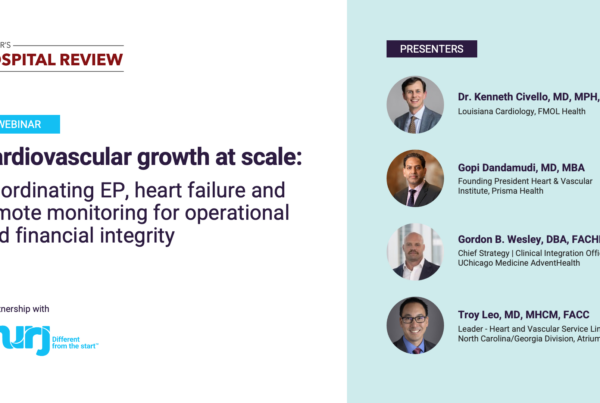


The upcoming launch of the the Centers for Medicare & Medicaid Services (CMS) Ambulatory Specialty Model (ASM) represents an important evolution in the cardiology landscape—prompting practices to prepare their clinical workflows, navigate new Medicare Part B performance measures, and transition toward structured longitudinal care for heart failure (HF) patients.
In this webinar hosted by Becker’s Hospital Review and sponsored by Murj®, moderator Dr. Kenneth Civello joins clinical and operational leaders to explore frameworks for everything from managing HF between visits to building the remote patient monitoring (RPM) infrastructure required for long-term success in the ASM era.
The panel dives into the practical steps required to bridge the gap between traditional episodic visits and continuous, team-based care, sharing blueprints for timely medical optimizations, sustainable clinician workflows, and improved patient outcomes.
From real-world approaches to repurposing familiar pacemaker clinic workflows to the operational benefits of specialized transition clinics and pharmacist-led titration, the conversation highlights both the strategic preparation needed for the ASM launch in 2027 and the positive opportunities ahead.
Watch the full discussion below, and read on to explore key takeaways and insights.
Faculty
- Kenneth Civello, MD, MPH, FACC, Electrophysiologist, Louisiana Cardiology, FMOL Health
- Roy Davis, Group Director, Operations, Medical Cardiovascular, Mercy Health
- Vicki Miller, DNP, RN, CPHQ, Director, System Advanced Heart Failure, Lee Health
- Sunthosh V. Parvathaneni, MD, FACC, FHRS, Regional Section Lead, Clinical Cardiac Electrophysiology, Mercy Central Communities & Asst. Professor, Univ. of Missouri/Mercy Hospital Springfield
Key takeaways
- Repurposing existing blueprints is the fastest path to scale: Cardiology practices should not build HF remote patient monitoring (RPM) from scratch, but instead translate the highly successful, nurse-led, and protocol-driven workflows of traditional pacemaker clinics to manage heart failure metrics.
- Standardized outpatient safety nets prevent hospital readmissions: Establishing rapid-access transition clinics and virtual, pharmacist-led medication titration programs manages vulnerable patients between episodic visits and keeps them out of the emergency department.
- Smart EHR filtering and triage combat clinical burnout: To prevent physicians from being overwhelmed by large amounts of daily remote data, systems must integrate AI-enabled filters and protocols to ensure clinicians only see actionable trends, not raw device alerts.